Evanston Game Reserve
How to Flirt with A Naked WerewolfEvanston Game Reserve is the massive protected wilderness surrounding Grundy, Alaska, and it gives the town both its setting and its most important human-wildlife boundary. The reserve is not a distant backdrop: it structures employment, romance, rescue work, local anxieties, and the recurring presence of wolves and other dangerous animals. Through the reserve, the novel connects ordinary community life with a landscape that remains powerful, unpredictable, and only partly governable.
Setting and Institutional Role
The reserve surrounds Grundy and is overseen by Alan Dahling, a U.S. Forestry ranger whose station lies five miles from Mo Duvall-Wenstein’s home as the crow flies. That distance makes Alan both a nearby neighbor and an official representative of the wilderness beyond the town’s settled spaces. His position gives him practical knowledge of the preserve and places him on the front line whenever residents or visitors misjudge the environment.
The reserve also helps define Grundy’s social geography. Mo’s work at the Blue Glacier Saloon brings her into contact with residents, while the reserve brings her into contact with the wider terrain and the people responsible for managing it. The setting therefore joins the town’s close-knit social network to a larger institutional landscape whose dangers cannot be handled by sociability alone.
Alan Dahling and the Work of Protection
Alan is the reserve’s most visible human representative. He is introduced as a tall, fit ranger with a sandy head of wavy hair, blue eyes, and a crisp green uniform, but his appeal is tied as much to his competence as to his appearance. He repeatedly occupies the role of the person who knows what the northern environment demands and what happens when newcomers fail to prepare.
His warning about would-be homesteaders is especially revealing. Each year, people arrive hoping to build cabins and live off the land in a Thoreau-like fashion; Alan generally ends up rescuing them from the top of a bluff because they lack suitable gear, clothing, food, or shelter. The reserve thus exposes the gap between romantic fantasies of wilderness independence and the practical knowledge required to survive there. Alan distinguishes Mo from those careless outsiders, assuring her that she possesses more common sense than most locals and treating her arrival as adaptation rather than reckless self-invention.
Protection is also part of Alan’s personal relationship with Mo. He offers to help whenever she needs anything and remains close enough to respond to trouble at her home. When a large black wolf is reported by campers on the preserve, a planned movie outing with Mo is canceled because Alan is called to a trail. His professional duty interrupts courtship, making the reserve an active competitor with domestic and romantic life rather than a neutral workplace.
Wildlife, Danger, and Local Knowledge
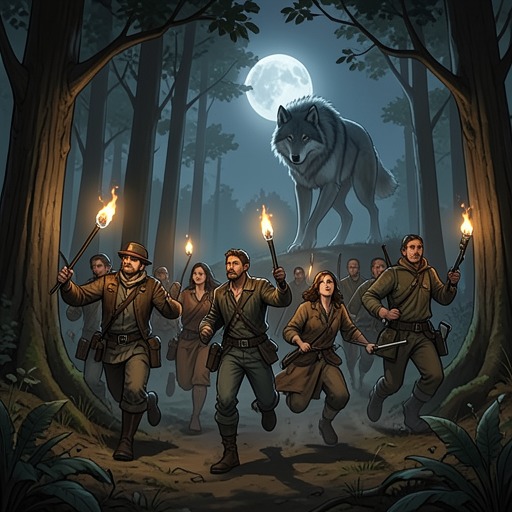
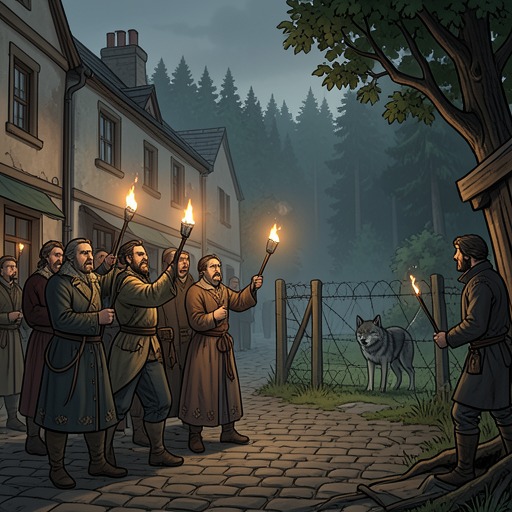
The reserve is a recurrent point of contact between Grundy and predatory wildlife. The report of a large black wolf seen by campers turns an ordinary date into a search or response operation, and the wolf’s appearance contributes to the atmosphere of uncertainty surrounding the town. The reserve is therefore both a protected space and a source of danger: its purpose is preservation, but its animals do not observe the boundaries that humans draw around settled life.
The reserve’s dangers are presented through practical consequences rather than abstract wilderness admiration. Unprepared visitors become rescue cases, campers report wolves, and residents depend on people with the training to interpret tracks, sightings, and threats. This emphasis gives the landscape a disciplinary force. It teaches that clothing, food, shelter, equipment, and preparation are not optional signs of sophistication but conditions of survival.
The same environment also carries social and symbolic meanings. Grundy’s men express romantic interest through a meat-offering tradition, treating the gift of a rump roast as a provider’s proposal to go steady. That custom belongs to the town rather than exclusively to the reserve, but it reflects the wider culture in which food, protection, physical competence, and masculine provision are closely connected. Against that local ideal, Alan represents a more service-oriented masculinity: his authority derives from rescue, knowledge, and care, not only from dominance.
Boundaries Between Town and Wilderness
The reserve marks several overlapping boundaries: resident and outsider, prepared and unprepared, human settlement and animal territory, and personal desire and public responsibility. Mo’s arrival in Grundy makes her initially vulnerable to being classified as an outsider, yet her work and practical competence gradually give her a place in the community. Alan’s reserve work provides a parallel model of belonging. He belongs because he can navigate the environment and protect others within it.
That boundary work becomes more complicated when Cooper Graham appears at Mo’s home and later gives Alan only the vague explanation that he was being neighborly. Alan’s response shows that the reserve’s protective authority overlaps with romantic competition: Alan wants to keep watch over Mo, while Cooper’s presence suggests a different, more intimate claim. The wilderness around the town makes those claims consequential because danger is not merely emotional or social; it can arrive in animal form at a person’s doorstep.
The reserve also complicates the distinction between official knowledge and local belief. Alan’s ranger expertise is grounded in observation and emergency response, while Grundy’s residents possess customs and suspicions that do not fit formal management. The novel does not make the reserve a simple emblem of scientific control. Instead, it presents a place where institutional authority, communal knowledge, and concealed supernatural realities coexist uneasily.
Narrative Significance
Evanston Game Reserve gives the story a durable physical structure for its conflicts. It supplies Alan with his vocation and proximity to Mo, creates credible reasons for his absences and interventions, and provides the landscape through which wolf sightings and wilderness emergencies enter the plot. At the same time, it enlarges the novel beyond the Blue Glacier Saloon and Grundy’s gossip, reminding readers that the community exists inside a much larger ecological system.
Its deepest significance lies in the contrast between human categories and environmental reality. People call the area a reserve, establish stations, manage trails, and distinguish safe town space from dangerous preserve space, yet animals still cross those divisions and the wilderness repeatedly exposes the limits of human confidence. The reserve is consequently both managed institution and resistant world: a place where protection is necessary precisely because control is incomplete.